
How to Source High-Quality Teak & Rattan Furniture from Indonesia


Sourcing furniture internationally for hospitality projects, wholesale distribution, or commercial developments can be a lucrative move provided you partner with the right manufacturer. Indonesia has long been recognized as the global epicenter for fine solid teak wood and handcrafted natural rattan furniture.
However, for overseas buyers, procurement managers, and interior designers, navigating the international supply chain requires clear criteria to ensure product durability, legal compliance, and seamless logistics.
Here is a comprehensive guide on how to successfully source export-grade teak and rattan furniture from Indonesia.
1. Prioritize Legally Certified Wood (SVLK / V-Legal)
When importing wooden furniture into markets like Europe, North America, or Australia, regulatory compliance is non-negotiable.
Indonesia enforces a strict legal timber assurance system known as SVLK (Sistem Verifikasi Kelestarian Pengelolaan Hutan Lestari) or V-Legal. This certification guarantees that:
- The teak wood is legally harvested from sustainably managed plantations (such as Perum Perhutani).
- The timber complies with global timber regulations, including the EU Deforestation Regulation (EUDR) and the U.S. Lacey Act.
- Your shipment will clear international customs without the risk of legal impoundment.
Procurement Tip: Always request the manufacturer’s SVLK certificate and V-Legal documentation before issuing a purchase order (PO).
2. Verify Wood Kiln-Drying and Moisture Content (MC)
One of the most common pitfalls when sourcing solid wood furniture from tropical countries is climate adjustment. Freshly cut teak wood carries high moisture levels. If shipped to dry or freezing international climates without proper treatment, the wood will shrink, warp, or crack.
- Target Moisture Content (MC): Commercial export-grade teak wood must be kiln-dried to achieve a moisture content of 8% to 12%.
- Stability: Proper kiln-drying stabilizes the timber, ensuring structural integrity and preventing joint separations during transit or seasonal changes overseas.
High-quality export furniture requires rigorous Kiln-Drying (KD):
3. Look for Grade-A Teak and Premium Natural Rattan
Not all materials are created equal. Understanding raw material grades ensures you pay the right price for the right quality:
- Teak Wood Grading:
- Grade A: Cut from the center (heartwood) of mature teak trees (30+ years old). Rich in natural protective oils, uniform golden-brown color, and highly weather-resistant.
- Grade B & C: Outer wood (sapwood) with lighter color tones, higher knots, and lower oil content—best suited for lower-budget indoor items.
- Rattan Selection:
- Ensure the factory uses solid, high-grade rattan poles (like Manau or Batang) for the primary structural frame, combined with tight, defect-free handweaving (skin or core wicker) for seating and backrests.
4. Choose a Factory Offering OEM / ODM Customization
For commercial projects such as hotels, resorts, and restaurants, off-the-shelf furniture rarely meets exact architectural specifications.
Partner with an Indonesian manufacturer that offers OEM (Original Equipment Manufacturer) and ODM (Original Design Manufacturer) capabilities:
- CAD & Blueprint Translation: The factory should be able to fabricate custom furniture directly from your designer’s CAD drawings or render 3D concepts.
- Custom Fabrics & Finishes: Look for options to integrate commercial-grade upholstery (such as fire-retardant foam, water-repellent outdoor fabrics, or custom stain colors).
5. Evaluate Factory Quality Control (QC) and Packaging Standards
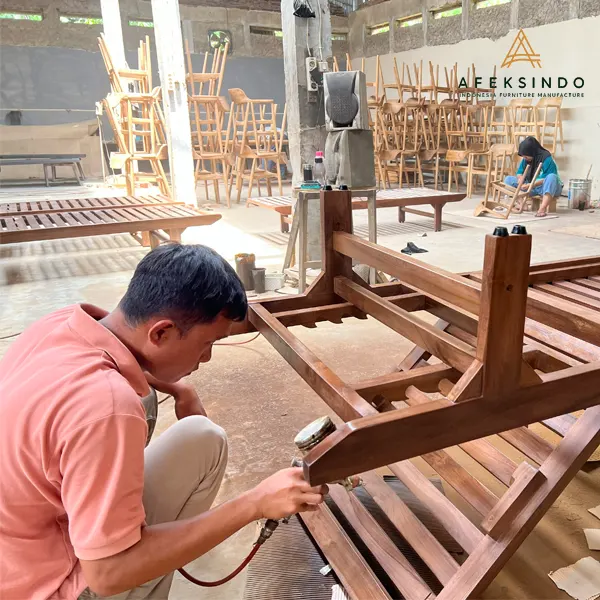
The manufacturing process is only as good as its Quality Control system. Reliable suppliers conduct multi-stage QC inspections:
- Raw Material Selection: Inspecting wood MC and sorting rattan poles.
- Structural Fabrication: Testing weight capacity, ergonomics, and joint strength.
- Finishing & Sanding: Ensuring smooth surfaces and non-toxic protective coatings.
- Pre-Shipment Assembly: Test-assembling furniture pieces before packing.
Furthermore, long-distance sea transport requires Export-Grade Packaging. Ensure your manufacturer utilizes heavy-duty corrugated cartons, edge protectors, moisture-absorbing silica gel packs, and protective bubble wrapping to prevent transit friction and mold growth inside shipping containers.
6. Work with Experienced Export Logistics Partners
Export logistics involve more than just filling a container. A seasoned exporter understands:
- Incoterms Flexibility: Offering transparent pricing based on FOB (Free on Board), CFR, or CIF terms.
- Container Optimization: Expertly calculating volume ($\text{CBM}$) to maximize space inside 20ft, 40ft, or 40ft High Cube (HC) containers, minimizing your shipping cost per unit.
- Export Documentation: Handling the Bill of Lading (B/L), Certificate of Origin (COO / Form A/E/D), Packing Lists, and Commercial Invoices accurately.
Partner with CV. Afeksindo Natural Inovatif
At CV. Afeksindo Natural Inovatif, we specialize in manufacturing and exporting custom contract furniture for global hospitality projects, wholesalers, and interior designers. Based in Indonesia, our production integrates sustainable SVLK-certified solid teak wood, premium natural rattan, and all-weather synthetic wicker.
Whether you require a full-container order for a resort development or custom OEM fabrication for a restaurant chain, our team provides end-to-end quality control and international shipping support.
Ready to Start Your Next Furniture Project?
- Request a B2B Quote (RFQ): Contact our sales engineering team today with your project specifications or CAD designs.
- Download Our Latest Catalog: Explore our complete range of hotel, restaurant, and outdoor furniture collections.
👉 [Contact Our Export Team] | [Download B2B Catalog (PDF)]